
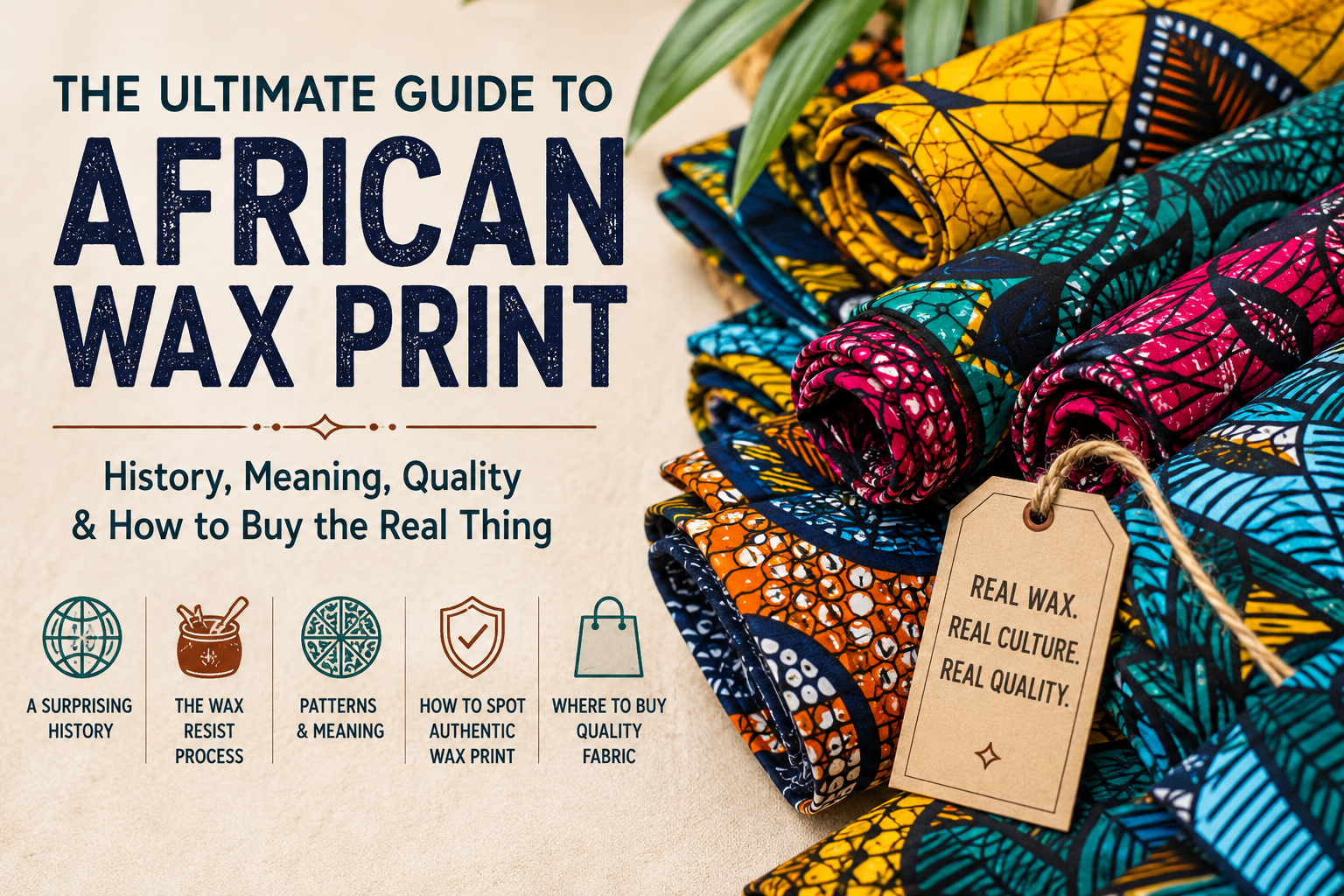
African wax print fabric is a vibrant, 100 percent cotton cloth decorated with bold, repeating patterns using a wax resist dyeing method, the same family of techniques behind Indonesian batik. You may also hear it called Ankara, Dutch wax, Holland wax, or kitenge, depending on where you are in the world. The thing that sets it apart from an ordinary printed cotton is simple: on a true wax print, the pattern shows with equal intensity on both sides of the cloth, often with a faint crackle or marbling running through the design. Today it is worn across West and Central Africa and throughout the diaspora as a marker of identity, celebration, and personal style.
That is the short answer. The history behind the cloth, how to tell the real thing from a cheap copy, and where the good stuff actually comes from is where it gets interesting.
A surprising history: Indonesia, the Netherlands, then West Africa
The story of African wax print does not begin in Africa, and that catches most people off guard.
In the 19th century, Dutch manufacturers set out to mass produce Indonesian batik using industrial roller printing instead of the slow hand drawn process. The machines left tiny cracks and uneven patches in the wax, so the Indonesian market, which valued precise hand work, largely rejected the imitations. West African markets, on the other hand, embraced them. One popular account credits West African soldiers recruited into the Dutch colonial army in the East Indies, sometimes called the Belanda Hitam or "Black Dutchmen," with carrying a taste for the cloth back home, though the trade routes that followed were broader and more tangled than any single origin story.
What happened next is the important part. West African buyers did not just accept the cloth. They reshaped it. Designs were commissioned to local taste, patterns were given names and meanings, and the fabric became woven into ceremony and everyday dress. A textile born of Indonesian craft and Dutch machinery became, over more than 150 years, a genuine West African cultural language.
The most famous maker, Vlisco, has produced wax print in Helmond, the Netherlands, since 1846 and still supplies the premium end of the market. Major production also runs out of Ghana, Nigeria, and Côte d'Ivoire today.
How African wax print is made
The "wax" in the name is not decoration. It is the method.
A resin or wax is applied to the cloth in the shape of the pattern. When the fabric is dyed, the dye cannot penetrate the waxed areas, so they resist the color and the design appears. Because the wax soaks through the cotton, the pattern develops on both faces of the cloth at once, which is why a real wax print has no clear "wrong side."
Those small irregularities, the hairline crackle and the soft bleeding of color along pattern edges, are not flaws. They are the fingerprint of the resist process and a signal that you are looking at real wax rather than a flat one sided print.
The grades of wax print: real wax, fancy print, and imitation
Not everything sold as "African print" is the same thing, and the price gap between grades is large. Knowing the difference protects your money.
Real wax (Dutch wax, wax hollandais). The top tier. Made with the genuine resist process, color on both sides, the characteristic crackle, and a firm hand before washing. Vlisco and West African mills like GTP and Uniwax sit here. Most expensive, most durable.
Fancy print (Java print). Roller printed directly onto one side of the cloth. Brighter and cheaper, but the back is faded and the depth of a true wax is missing. Fine for many uses, just not the same product.
Imitation wax. Mass produced copies, often flooding markets at very low prices and frequently undercutting West African producers. Thin cotton or cotton blends, color that bleeds, patterns that fade fast.
If a listing is vague about which of these you are buying, treat that vagueness as your answer.
More than fabric: the language of patterns
Wax print patterns carry meaning. Many designs have names and stories attached, and historically women used their cloth choices to signal status, mark an occasion, or send a quiet message. Specific prints get tied to weddings, funerals, festivals, and political moments. A single piece can say something the wearer never speaks aloud.
This is the part a generic seller will never tell you, and it is the part that makes the cloth worth choosing with care. You are not buying a length of cotton. You are buying a piece of a living tradition.
How to spot authentic African wax print
Use this quick checklist before you buy, especially online:
Check both sides. On real wax, the pattern is nearly as vivid on the back as the front. A pale, washed out reverse points to a fancy or imitation print.
Look for the crackle. Faint veins and marbling in the design are a sign of the true resist process.
Read the selvedge. The unprinted edge often carries the maker's name or stamp. Trusted mills brand their cloth.
Feel the hand. Genuine wax has a slightly stiff, waxy feel before its first wash and softens over time.
Watch for color bleed. Quality wax holds its color. Dye that runs in the first wash signals a cheaper print.
Demand specifics. A trustworthy listing names the material, the origin, and the grade. Generic "African print fabric" with no detail is a weaker signal than a description that commits to facts.
Where to buy quality African wax print online
The hard part is not finding wax print. It is everywhere. The hard part is finding sellers who tell you the truth about what they are selling.
Look for product pages that explain material, origin, and grade, that show close up photos of both sides and the texture, and that give you full sizing and care information. When a piece is handmade, an artisan backstory or cultural context is a strong sign you are dealing with someone who respects the craft.
Sokofa is built around exactly that standard: a curated marketplace connecting shoppers to verified vendors of African fashion, art, beauty, and cultural products. You can browse by category and filter by product type to find the piece that fits your purpose, whether you are buying for yourself, choosing a gift, or sourcing fabric for a project.
Start here:
Frequently asked questions
What is African wax print fabric made of? It is almost always 100 percent cotton, patterned through a wax resist dyeing process. Cheaper imitations sometimes use thinner cotton or cotton blends, which is one reason quality varies so widely.
Is African wax print fabric actually African? The technique traces back to Indonesian batik, and industrial production began with Dutch manufacturers in the 1800s. Over more than a century, West African cultures adopted the cloth, redesigned it to local taste, named its patterns, and gave it deep social meaning. By any reasonable measure it has become a West African cultural textile, even though its roots are global.
What is the difference between Ankara and wax print? The terms overlap heavily. "Ankara" is the common name for African wax print across West Africa, particularly Nigeria. In everyday use they refer to the same kind of patterned cotton cloth.
How can I tell if wax print is authentic? Check that the pattern is strong on both sides, look for the natural crackle in the design, find a maker's stamp on the selvedge, and confirm the color does not bleed. Real wax also feels slightly stiff before its first wash.
How do I care for African wax print fabric? Wash in cold water, ideally by hand or on a gentle cycle, turn the piece inside out, avoid harsh detergents and bleach, and dry away from direct sun to protect the colors. Treated well, quality wax lasts for years and softens beautifully with age.
Final thread
The best place to buy African wax print is the seller who treats the cloth as a story rather than a stock item. Now that you know what it is, where it came from, and how to tell real from imitation, you can shop with a sharper eye. Browse the Sokofa categories above, check the vendor details, take your time comparing, and choose the piece that means something to you.