
Some of the most loved things in the world were mistakes first.
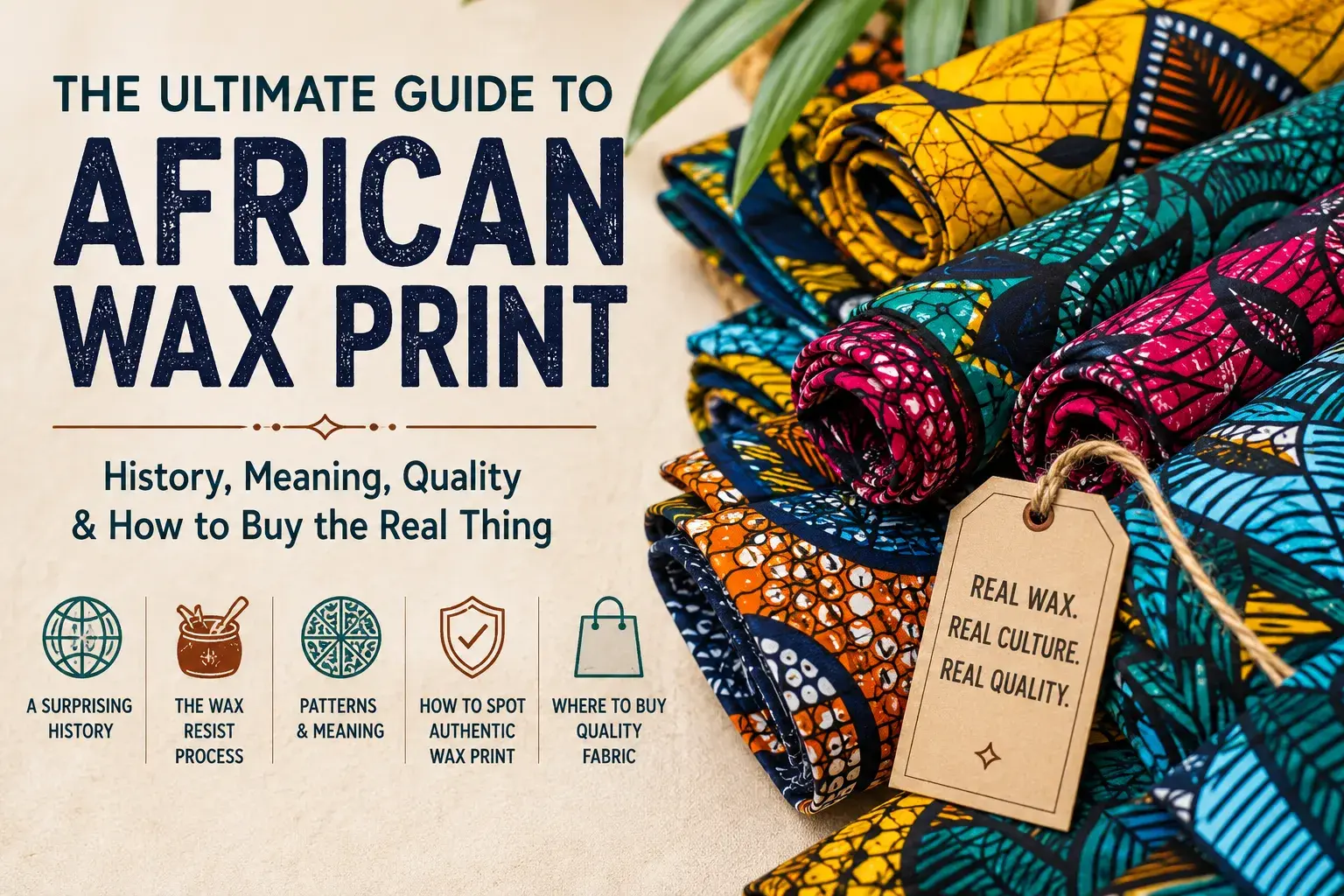
African wax print is one of them. The bright, bold cloth you see at weddings and festivals, wrapped into headties and tailored into sharp dresses, the fabric people across the world now think of as deeply, proudly African, did not start in Africa at all. It started as a copy that went wrong. And that is where its story gets good.
A copy that nobody wanted
Travel back to the 1800s. In Indonesia, artisans had spent generations perfecting batik, a way of patterning cloth by hand using wax and dye. The work was slow, careful, and beautiful.
Dutch manufacturers saw money in it. They built machines to make batik faster and cheaper, hoping to sell it back to the Indonesian market. But the machines were not as gentle as human hands. The wax cracked. Little veins and uneven patches crept into the patterns. To Indonesian buyers, who prized perfect handwork, these cloths looked flawed, and they turned them down.
The Dutch were left with shiploads of fabric and nowhere to sell it. So they tried other ports. And on the coast of West Africa, something unexpected happened. People did not see flaws. They saw color, life, and possibility. They loved it.
The rejected copy had found the place it was always meant to be.
How the magic actually works
To understand why the cloth looks the way it does, it helps to know the simple trick behind it.
Wax is laid onto the fabric in the shape of a pattern. Then the cloth is dyed. The dye soaks into the bare areas but cannot pass through the wax, so the waxed parts stay clear and the design appears. Because the wax sinks right through the cotton, the pattern comes out on both sides of the cloth at once. That is why a real wax print has no back and front. Both faces look almost the same.
And those tiny cracks that the Indonesian market disliked? They never left. The faint crackle and the soft blur where colors meet are still there today. Far from being faults, they became the signature, the proof that a cloth is the real thing and not a flat machine copy.
The mistake turned into the mark of quality.
When the cloth learned to speak
West Africa did not just buy the fabric. It took the fabric over.
Designs were reworked to local taste. Patterns were given names and meanings. A print could stand for wealth, for marriage, for a proverb, for a moment in the news. Women learned to read these cloths and to choose them with intent, so that what someone wore to a wedding or a funeral or a celebration could say something out loud without a single word being spoken.
Over more than 150 years, a fabric born of Indonesian craft and Dutch machinery became a true West African language, worn across the region and carried by the diaspora around the world.
The most famous maker, Vlisco, has produced wax print in the Netherlands since 1846 and still sits at the luxury end. But today much of the finest cloth comes from West Africa itself, from mills in Ghana, Nigeria, and Côte d'Ivoire.
The new counterfeit problem
There is a twist in the modern chapter, and it rhymes with the beginning.
The cloth that once arrived as a cheap copy is now threatened by cheap copies of its own. Mass produced imitations, often thin and quick to fade, flood the market at low prices and undercut the real West African makers. Sold under vague labels, they borrow the look of wax print without the craft behind it.
So once again the question is the same one the cloth has always asked. Is this the real thing, or a hollow imitation wearing its face?
The good news is that real wax print tells the truth about itself, if you know how to look.
How to read a cloth
Before you buy, especially online, let the fabric prove itself.
Turn it over. On real wax, the pattern is almost as strong on the back as the front. A pale, washed out reverse means it was printed on one side only, a sign of a cheaper grade.
Find the crackle. Those faint veins running through the design are the fingerprint of the true wax process.
Check the edge. The plain strip along the side, the selvedge, often carries the maker's name or stamp. Trusted mills sign their work.
Feel it. Genuine wax has a slightly stiff, waxy hand before its first wash, and softens beautifully over time.
Trust holding color. Quality wax keeps its color. Dye that runs in the first wash is a warning.
Ask for specifics. A seller who names the material, the origin, and the grade is showing respect for the cloth. One who hides behind "African print fabric" with no detail is telling you something by saying nothing.
Where to find the real thing
The hard part was never finding wax print. It is everywhere. The hard part is finding sellers who tell you the truth about what they are selling.
Sokofa is built for that: a curated marketplace connecting shoppers to independent makers of African fashion, art, beauty, and cultural products. Instead of guessing, you can shop from sellers who can name the maker and the origin, and choose cloth that carries the real tradition rather than a faded copy of it.
Start here:
Browse slowly, read the vendor details, and pick the piece that says what you want it to say.
Frequently asked questions
What is African wax print made of? Almost always 100 percent cotton, patterned using a wax resist dyeing process. Cheaper imitations sometimes use thinner cotton or blends, which is one reason quality varies so much.
Is African wax print really African? Its roots are global. The technique comes from Indonesian batik, and machine production began with the Dutch in the 1800s. But West Africa adopted the cloth, redesigned it, named its patterns, and gave it deep meaning over generations. It has become a West African cultural textile in every way that counts.
What is the difference between Ankara and wax print? Very little. "Ankara" is simply the common name for African wax print across West Africa, especially Nigeria. In everyday use they mean the same patterned cotton cloth.
How can I tell if wax print is authentic? Look for a strong pattern on both sides, the natural crackle in the design, a maker's stamp on the edge, and color that does not bleed. Real wax also feels slightly stiff before its first wash.
How do I care for it? Wash in cold water, by hand or on a gentle cycle, turn it inside out, skip harsh detergents and bleach, and dry it out of direct sun. Treated well, good wax print lasts for years and only gets softer.
The last thread
African wax print began as a copy nobody wanted and became a cloth that speaks for the people who wear it. That is a rare kind of story for a length of fabric to carry, and it lives on in every real piece.
Buy from a seller who treats it as a story and not just stock, and you do not simply own a beautiful cloth. You own a chapter of one of the most surprising journeys in the history of what we wear. Browse the Sokofa pages above, take your time, and choose the piece that means something to you.